.png)
If you've ever tried to coordinate multiple service technicians, juggle emergency calls, and keep customers happy all at the same time, you know the headache of field service scheduling. It's like playing Tetris with people, trucks, and time slots—except the pieces keep changing shape and your customers are calling asking where their technician is.
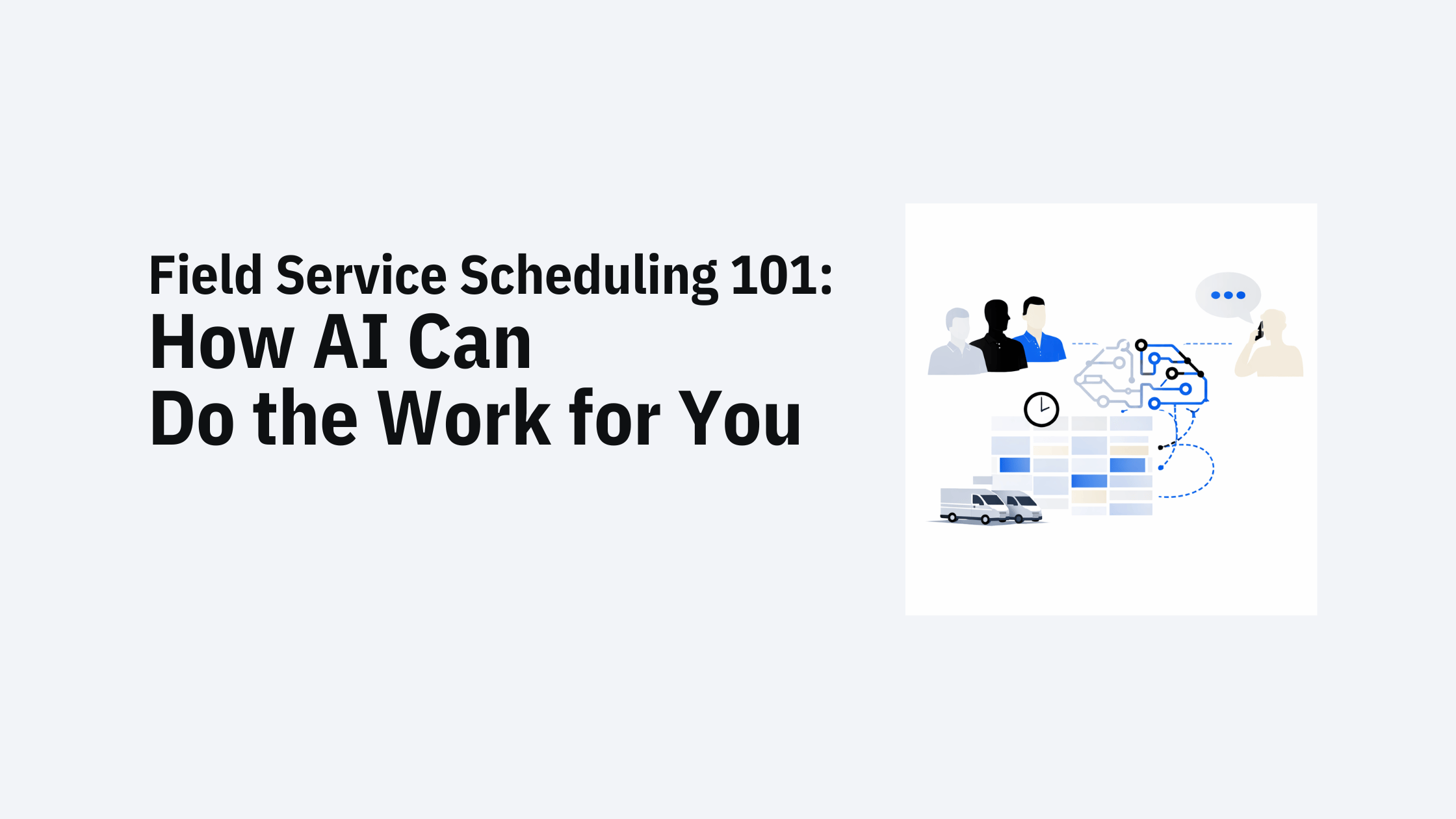
The good news? Artificial Intelligence is transforming this chaos into streamlined operations. Let's break down how AI scheduling works and why it might be the solution your field service business has been waiting for.
Picture this: You're a scheduler at an HVAC company. It's Monday morning, and you have 47 service calls to assign across 8 technicians. Each technician has different skills, certifications, and availability. Some jobs need to happen within specific time windows. Others are urgent emergencies that just came in. And oh, by the way, two of your technicians are stuck in traffic because you didn't account for rush hour congestion.
Sound familiar?
Research shows that 72% of businesses still plan routes manually. For small operations with a handful of daily jobs, a human planner can manage just fine. But as your business grows, manual scheduling becomes increasingly problematic:
The Hidden Costs of Manual Planning:
The real kicker? All these inefficiencies translate directly to your bottom line through wasted fuel, overtime wages, fewer jobs completed per day, and frustrated customers waiting longer than necessary.
When people hear "AI scheduling," they might imagine some mysterious black box making random decisions. In reality, it's more like having a brilliant logistics expert who never sleeps, never takes vacation, and can consider thousands of factors simultaneously.
Here's the simple version of what's happening behind the scenes with AI route optimization:
The AI needs information about your operation:
Instead of trying every possible combination (which would take years even for a supercomputer), the AI uses sophisticated algorithms that have been refined over decades. Think of it as the AI exploring the most promising solutions first, constantly improving its answer until it finds routes that are near-perfect.
The algorithm considers factors that would make a human planner's head spin:
What might take an experienced human planner 2-3 hours to figure out, AI scheduling solves in seconds. And when something changes—like an emergency call coming in at 2 PM—the AI can immediately recalculate and suggest the best way to fit it in without destroying everyone's day.
Let's look at how OnRoute's AI scheduling handles the challenges that keep field service managers up at night.
Home healthcare providers face complex scheduling puzzles. Nurses need to prepare patients before doctors arrive. Physiotherapists need to follow up after certain treatments. Each patient has preferred practitioners they're comfortable with.
The Challenge: Coordinating multiple professionals visiting the same patients in the right sequence, while respecting patient preferences and practitioner schedules.
How Solvice OnRoute Handles It: The AI uses "job relations" to understand that certain tasks must happen in sequence or be performed by the same team. When scheduling the day:
The Result: Patients receive consistent, coordinated care. Practitioners have manageable, logical routes. The scheduling team can focus on patient care instead of spreadsheet gymnastics.
Check the case of More-Life as an example.
It's 95 degrees outside, and your company just received a call about a broken air conditioner in an office building. You already have a full schedule of maintenance appointments planned for the day.
The Challenge: Finding the best technician to handle the emergency without completely disrupting other scheduled appointments or making customers wait unreasonably.
How Solvice OnRoute Handles It: OnRoute's suggest functionality analyzes your existing schedule in real-time:
The Result: The system might suggest: "Send technician Mike at 2:15 PM. He's only 8 minutes away and has a 30-minute window before his next appointment. This will delay his 3:00 PM appointment by only 15 minutes, and that customer has flexible timing."
Fairness matters. Nobody wants to be the technician who consistently gets the longest routes or works until 7 PM while colleagues finish at 4 PM.
The Challenge: Creating schedules that distribute work equitably while still maintaining route efficiency.
How OnRoute Handles It: The AI doesn't just optimize for speed—it optimizes for workload balancing. It actively balances:
The Result: Technicians develop familiarity with their areas (which improves service quality), and everyone feels the workload is fair. This leads to better employee satisfaction and lower turnover. Learn more about route optimization for pest control.
A landscaping company has some jobs that require a single worker (lawn mowing) and others that need a full crew (tree removal). Equipment must be shared across teams.
The Challenge: Coordinating who works together, ensuring the right equipment is available, and scheduling multi-person jobs efficiently.
How OnRoute Handles It: The system understands resource dependencies and skill-based matching:
The Result: Crews arrive together with the right equipment. No more situations where the tree removal team shows up but the wood chipper is still at yesterday's job site.
At its core, AI scheduling isn't about replacing human judgment—it's about freeing your team to focus on what humans do best: solving problems, building customer relationships, and growing your business.
The tangible benefits businesses see with Solvice OnRoute:
For businesses with recurring customers and multi-day scheduling needs, OnRoute handles complex patterns like weekly visits, bi-weekly maintenance, and seasonal services.
One of the biggest misconceptions about AI scheduling is that it's complicated to implement. The reality? Modern solutions like OnRoute are designed to be accessible.
The basic process looks like this:
Most importantly, you don't need a computer science degree or a dedicated IT team. The Solvice documentation provides comprehensive guides, and the quickstart tutorial can get you up and running in under 5 minutes.
Here's something that might surprise you: optimized routing isn't just good for your business—it's good for the planet. When your technicians drive 20-40% fewer miles, that translates to:
In an era where customers increasingly care about environmental responsibility, route optimization becomes part of your sustainability story.
If you're thinking about moving from manual scheduling to AI-powered optimization, here are the key questions to ask:
Does the solution handle your specific complexities?
Is it actually practical?
Will it grow with you?
The field service industry is changing rapidly. Companies that embrace AI scheduling aren't just saving time and money—they're building more resilient, scalable operations that can adapt to whatever comes next.
Unlike general-purpose routing tools, specialized field service optimization platforms understand the unique complexities of your industry—from skill requirements and job sequences to equipment needs and customer preferences.
But here's the important part: the best AI scheduling doesn't eliminate the human element. It enhances it. Your schedulers become strategic decision-makers instead of spreadsheet warriors. Your technicians get predictable, fair routes. Your customers get better service.
The question isn't whether AI can do the work for you. It's whether you're ready to let it.
Ready to see how AI scheduling could transform your field service operations? OnRoute by Solvice offers powerful optimization capabilities designed specifically for the complexities of field service. Whether you're managing healthcare visits, HVAC repairs, pest control, landscaping, or any other field service operation, intelligent scheduling can help you do more with less stress.
Start with a free trial or explore the documentation to see how easy implementation can be. For complex use cases or questions about how OnRoute can solve your specific challenges, connect with the Solvice team for expert guidance.
.png)