


A workforce management platform for mobile teams needed scheduling that went past a fixed set of rules. Its customers plan against workload balance, resource skills and real drive times, and every one of them weights those differently. The platform embedded Solvice rather than building a solver of its own, and shipped optimization as a feature of its product. Customers report a 64% increase in jobs completed.
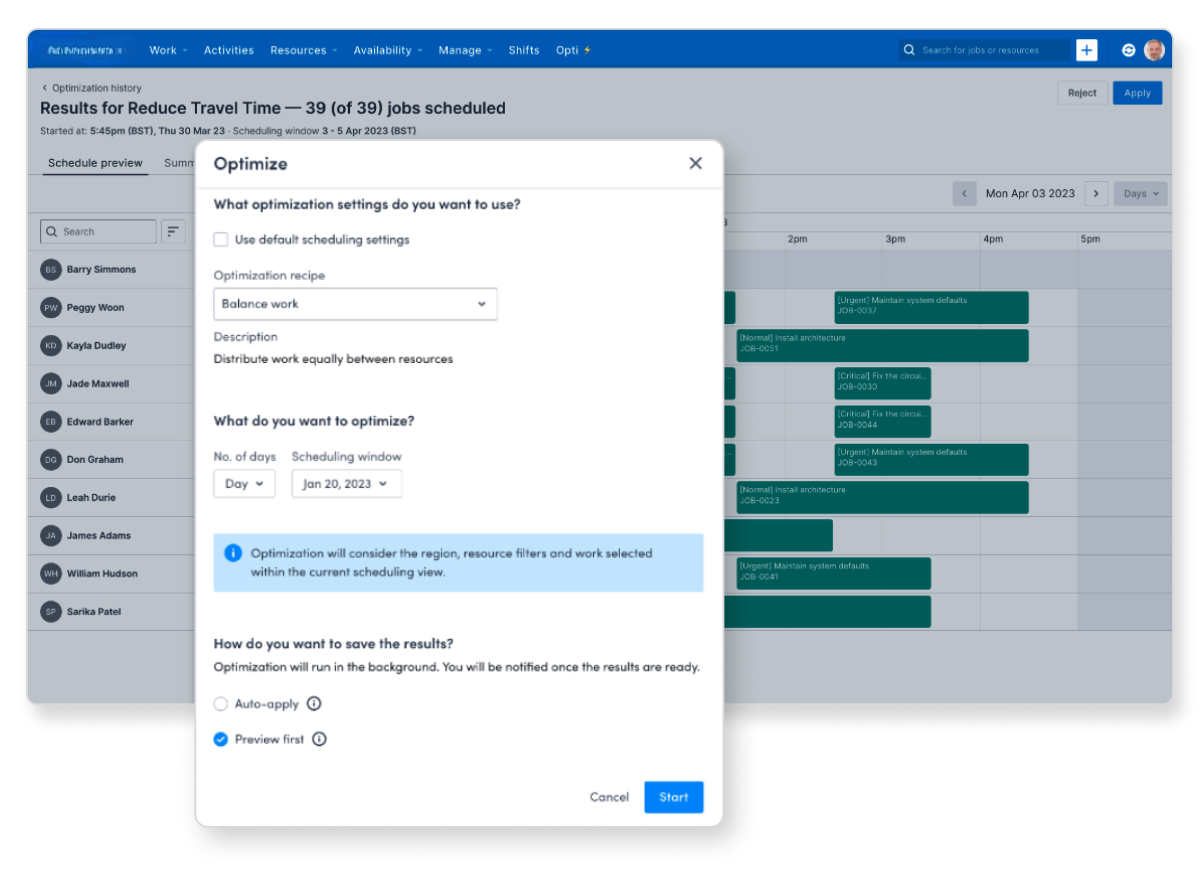
Scheduling a mobile workforce is not one problem. It is one problem per customer. An operator balancing workload across a service team, one matching technician skills to jobs, and one planning around morning traffic all ask for the same feature and want a different answer out of it.
A workforce management platform serving all of them has two options. Ship a fixed set of scheduling rules and accept that every customer eventually finds the edge of it, or build a solver. Building one means hiring optimization specialists and maintaining a constraint model that grows with every customer request.
The platform embedded Solvice instead. Scheduling stayed a feature of its own product, with the solver underneath it: constraint-based optimization across workload balance, resource skills and historical traffic data, resolved in a single solve rather than applied as a sequence of rules.
Customers tune what the solver optimizes for. Configurable optimization settings let each organization weight the factors that matter to its operation, so the same feature returns one schedule for a team protecting against overtime and another for a team maximizing coverage.
Drive time is modeled on historical traffic rather than straight-line estimates, so a route reflects the roads as they are at the hour it will be driven. That cuts windshield time, which is the part of a mobile worker's day that produces nothing.
Customers report a 64% increase in jobs completed after moving to the feature. The same teams handle more appointments in the same hours, because the schedule stops leaving capacity on the table.
The platform ships and maintains no solver of its own. New constraint coverage arrives through the API, and its engineers spend their time on the product its customers actually log into.